Traffic is up. The ads are running. People are landing on your store — and the orders still aren't coming in.
If that's where you are right now, you're not alone, and you're not doing something obviously wrong. Walk into any Shopify founder community and you'll find the same post on repeat: "I'm getting traffic but no sales. I've spent everything on ads and still nothing. The store looks good and loads fast — so what am I missing?"
Here's the uncomfortable truth: you probably don't have a traffic problem. You have a buying-decision problem.
More traffic is not automatically the answer. A redesign is not automatically the answer. The first answer is evidence — and that's what the rest of this article is about.
Most founders respond to flat sales by doing more of what got them the traffic in the first place — more ads, more content, more discount codes. But pouring more visitors into a store that isn't converting is like turning up the volume on a conversation nobody can hear. The fix isn't more noise. It's removing the friction that's stopping people who already arrived from saying yes.
[ 01 / Benchmarks ]Where most Shopify stores actually stand
According to Littledata's Shopify benchmarks, the average store converts around 1.4% of visitors. Stores converting above 3.2% enter the top 20%, while those above 4.7% enter the top 10%. The average Shopify add-to-cart rate is approximately 4.6%.
Meanwhile, Baymard's research places average ecommerce cart abandonment at just over 70%.
Benchmarks vary considerably by product category, price point, device, customer familiarity and traffic source. The useful question isn't simply whether your store is "above average" — it's where your own conversion path is breaking down.
[ 02 / Framework ]The four points of commerce failure
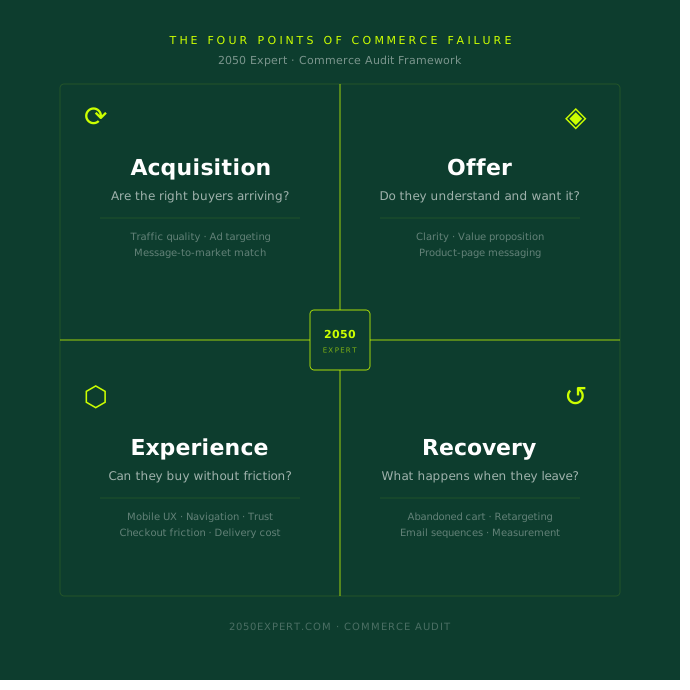
Every conversion problem we see at 2050 Expert sits within one or more of four areas:
- Acquisition — Are the right buyers arriving?
- Offer — Do they understand and want what's being sold?
- Experience — Can they evaluate and purchase it without unnecessary effort?
- Recovery — What happens when they leave without buying?
A Commerce Audit examines all four. This article focuses on the three areas you usually have the most direct control over right now — Offer, Experience and Recovery — because that's typically where the fastest wins sit. Acquisition (whether the traffic itself is the right traffic) is a different diagnosis, and one worth asking honestly — we'll come back to it in the FAQ.
Here are nine of the most common leaks, grouped under the part of the system they tend to sit within.
[ 03 / Offer ]Offer: do they understand and want what you're selling?
1. Your offer isn't actually clear
Visitors land on your homepage or product page and within seconds they're asking: what is this, who is it for, and why should I care? If the answer takes more than a glance to work out, most people won't stick around to figure it out. A confused visitor doesn't convert — they bounce. This is the single most common leak, and it's invisible to founders because you already know what you're selling. Your customers don't have that advantage.
2. Weak product-page messaging
Traffic might be landing on your homepage, but sales happen on the product page. If that page reads like a spec sheet rather than an answer to "what does this do for me," you're asking customers to do the persuasion work themselves. Strong product pages sell the outcome, address the hesitation, and make the next step obvious — all without the visitor having to dig.
[ 04 / Experience ]Experience: can they evaluate and buy without friction?
3. A poor mobile experience
The majority of your traffic is almost certainly on a phone. If your store was designed (or just never checked) on a desktop screen, there's a good chance buttons are too small, images load slowly, or the checkout flow is awkward to navigate with a thumb. Every extra tap, every slow load, every element that doesn't quite fit the screen is another reason for someone to give up.
4. Lack of trust evidence
People don't buy from stores they're not sure are real. Reviews, testimonials, recognisable payment badges, clear contact details, a returns policy that's easy to find — these aren't decoration. They're the things that quietly answer the question every new visitor is asking: can I trust this enough to enter my card details? If that question goes unanswered, so does the sale.
5. Confusing navigation
If a visitor has to think about where to click next, you've already lost momentum. Too many categories, unclear labels, or a search function that returns nothing useful all create small moments of friction — and friction compounds. By the time someone has clicked around three menus trying to find what they came for, most people have quietly closed the tab.
6. Unexpected delivery costs
This one is brutally simple and brutally common: a customer adds an item to cart, gets through to checkout, sees a delivery charge they weren't expecting, and abandons. Surprise costs at the final step are one of the most reliable conversion killers in ecommerce — and one of the easiest to fix once you know it's happening.
7. Friction at checkout
Every additional field, every forced account creation, every step that isn't strictly necessary is a chance for someone to change their mind. The best checkouts feel almost invisible — fast, minimal, and free of anything that makes the customer stop and think twice.
[ 05 / Recovery ]Recovery: what happens when they leave without buying?
8. Weak post-visit follow-up
Not everyone buys on the first visit — and that's normal. What's not normal is having no system to bring them back. If someone abandons a cart, browses without buying, or signs up for your list and then hears nothing, you're relying entirely on first-visit conversion to do all the work. That's an expensive way to run a store.
9. No measurement of where buyers leave
Here's the leak underneath all the others: if you don't know where in your funnel people are dropping off, you're guessing at fixes. Without visibility into the actual buyer journey — where people land, where they hesitate, where they leave — every change you make is a shot in the dark. Some will land. Most won't. And you'll have no way of knowing which is which.
[ 06 / Diagnosis ]A redesign without a diagnosis is a guess with a bigger budget
Here's where most founders go wrong next: they look at a list like the one above, conclude the whole site needs rebuilding, and commission a full redesign. Months later, the new store looks better — and converts at almost exactly the same rate.
That happens because a redesign without a diagnosis is a guess with a bigger budget. You're changing the wrapping without knowing what was actually broken inside.
The pattern is recognisable: the homepage changes, the typography improves, the photography gets sharper — and the commercial questions remain exactly as unanswered as before. The offer is still hard to understand. The customer path is still disjointed. Nobody has established where buyers are actually leaving. The redesign may have delivered precisely what was commissioned — a better-looking website. A better-looking website and a better-performing commercial system are not the same deliverable.
The business bought design when it needed diagnosis.
The way to avoid that isn't to look harder at the homepage. It's to look at the path between attention and revenue. Where is the traffic landing? Are people viewing products? Are they adding to basket? Are they reaching checkout — and where does the behaviour fall away? If visitors arrive and leave almost immediately, that points toward acquisition or message-match. If they view products but don't add to basket, the issue likely sits with the offer, pricing or buying confidence. If they add to basket but stall at checkout, the design has already done its job — something later in the process is breaking the decision. The first question isn't "does this site look good?" It's "what is the customer doing, and where do they stop?"
The cost of not knowing is easy to underestimate. Consider a store receiving 10,000 visits a month at a 1% conversion rate, with an average order value of £60 — that's roughly £6,000 in monthly revenue. Move conversion to 1.5%, without spending another pound on traffic, and the same visitors produce around £9,000. That's the kind of figure a conversion leak represents before you've touched your ad budget at all.
(That example is illustrative, not a promise — the point is that the upside of finding the leak is usually larger than the cost of looking for it.)
You don't necessarily need another redesign. You need to know precisely where revenue is being lost — before spending more money fixing the wrong thing.
[ 07 / FAQ ]Frequently asked questions
Why am I getting traffic but no sales on my Shopify store?
In most cases, it comes down to one or more of four areas: the right buyers aren't arriving (acquisition), the offer isn't landing (offer), something in the buying experience is creating friction (experience), or there's no system for bringing back people who didn't buy first time (recovery). Traffic proves people are reaching your store. It doesn't prove that the right people are arriving, that the offer is landing, or that the buying experience is doing its job.
Is my Shopify website the problem, or is it my ads?
Check whether the visitors you're already getting are taking any action — adding to cart, viewing more than one page, spending more than a few seconds on site. If most leave immediately with no engagement at all, traffic quality (acquisition) is worth scrutinising first. If visitors are engaging — viewing products, adding items to their basket — but failing to complete checkout, the problem is more likely to sit within the offer, the buying experience, the trust proposition or the checkout process than with traffic volume alone.
Why are people adding to cart but not buying?
This is one of the clearest signals in ecommerce: it means your offer was compelling enough to act on, but something between cart and checkout — cost, friction, trust, timing, or a technical issue — broke the momentum. It's also one of the easier leaks to fix once it's been correctly identified.
Should I redesign my Shopify store, or fix specific issues?
In most cases, the evidence should determine that decision rather than a hunch. A full redesign without knowing what's actually broken tends to produce a better-looking store that converts at roughly the same rate — because looking better and selling better aren't the same outcome.
We've been on the other side of this question too. When we repositioned 2050 Expert itself, it would have been easy to assume the answer was a more impressive website — stronger visuals, sharper case studies, a more polished brand. Those things mattered, but they weren't the actual constraint. The real gap was the route from expertise to purchase: what could someone buy first, why now, and what happened next. That's a structural question, not a cosmetic one — and it's what led to the Commerce Audit as its own product.
A Commerce Audit identifies the specific points where revenue is being lost — by tracing where visitors arrive, where they engage, and where they stop — so any changes you make afterwards, redesign or otherwise, are targeted rather than cosmetic.
[ 08 / CTA ]Stop guessing at what is costing you sales
A Shopify store can look polished, load quickly, and still lose revenue at several points between the first visit and a completed checkout.
The challenge is that the most visible issue is rarely the most expensive one.
You may have an acquisition problem, an offer problem, an experience problem, or a recovery problem — or several working against each other at once. Until those possibilities are assessed against your actual store and customer path, changing themes, increasing ad spend, or adding more apps is still guesswork.
The 2050 Expert Commerce Audit examines the commercial system behind your store. It identifies where buyers are being lost, distinguishes high-impact issues from cosmetic ones, and gives you a prioritised plan for what to address first.
It may conclude that your store does need substantial redesign work — in which case you'll know exactly which pages, decisions and customer behaviours that redesign needs to improve. It may also show that the highest-value changes are much smaller: stronger product positioning, better trust evidence, a simpler checkout, recovery emails that actually run, or a correction to where your traffic is coming from. Either way, you'll be spending the next pound with evidence behind it rather than a hunch.
The real choice isn't £1,300 versus £5,000. It's £1,300 to make an informed decision, or risking £5,000 on an assumption.
That's also the difference between an audit and a sales pitch for more work: a responsible adviser has to be willing to find the answer that produces less implementation work for them. That's the position the Commerce Audit is built from.
Is the Commerce Audit the right next move?
Book a 15-minute Commerce Fit Call. On the call, we'll establish:
- What's happening in your store right now
- What you've already tried
- Whether the problem is suitable for a Commerce Audit
- Whether the likely commercial value justifies the investment
This call is best suited to established businesses with a live ecommerce store, measurable traffic, and a genuine intention to improve commercial performance. Bring your store URL and, where available, your recent traffic, conversion-rate and average-order-value figures.